
Heritage flour brand

The question
A legacy German flour brand faced a pressure every heritage category eventually meets: the shelf was moving, and its packaging wasn't. Six redesigns had been drafted - from careful refreshes to more confident departures. The operational question, which one looks best, was the wrong one. The real question was psychological. Decades of loyal purchase behavior had been anchored to a specific visual covenant between brand and buyer. Some elements of that covenant were carrying real trust. Others were decorative residue. Change the decorative elements and the brand modernizes. Change the trust-carrying elements and the brand silently breaks - recognition drops, the hand hesitates at shelf, the category leader quietly loses its hold.
No focus group can resolve this. A consumer cannot consciously report which elements of a bag of flour carry their trust.
How we worked it
We ran the six variants through a depth-psychological simulation calibrated to the brand's long-term consumer architecture. Each design element was isolated and read for its role in the psychological contract - which elements were carrying identification, which were signalling heritage, which were functioning as pure decoration. The variants were then recomposed and read as systems, because consumers never experience an element in isolation; they experience the gestalt.
Two readings ran alongside the simulation. A structured attention analysis traced where the eye settled on each variant and where it skipped - confirming or contradicting what the psychology predicted a shopper would actually register at shelf distance. A contextual validation placed the variants back inside the category environment; a bag of flour is never seen on a white background. It is seen next to seven competitors in three seconds of peripheral vision.
What emerged
A clear hierarchy among the six variants - but, more importantly, a map of which design moves constituted genuine evolution and which would have read as indecision. One set strengthened shelf presence without touching the trust-carrying architecture. Another set modernized elements consumers never consciously noticed but unconsciously relied on, and would have lost volume within the first re-buy cycle.
The brand moved forward with a decision anchored in consumer psychology rather than internal aesthetic preference - closing, in a fraction of the time traditional shelf research would have required, a redesign conversation that in most heritage brands circles for months.
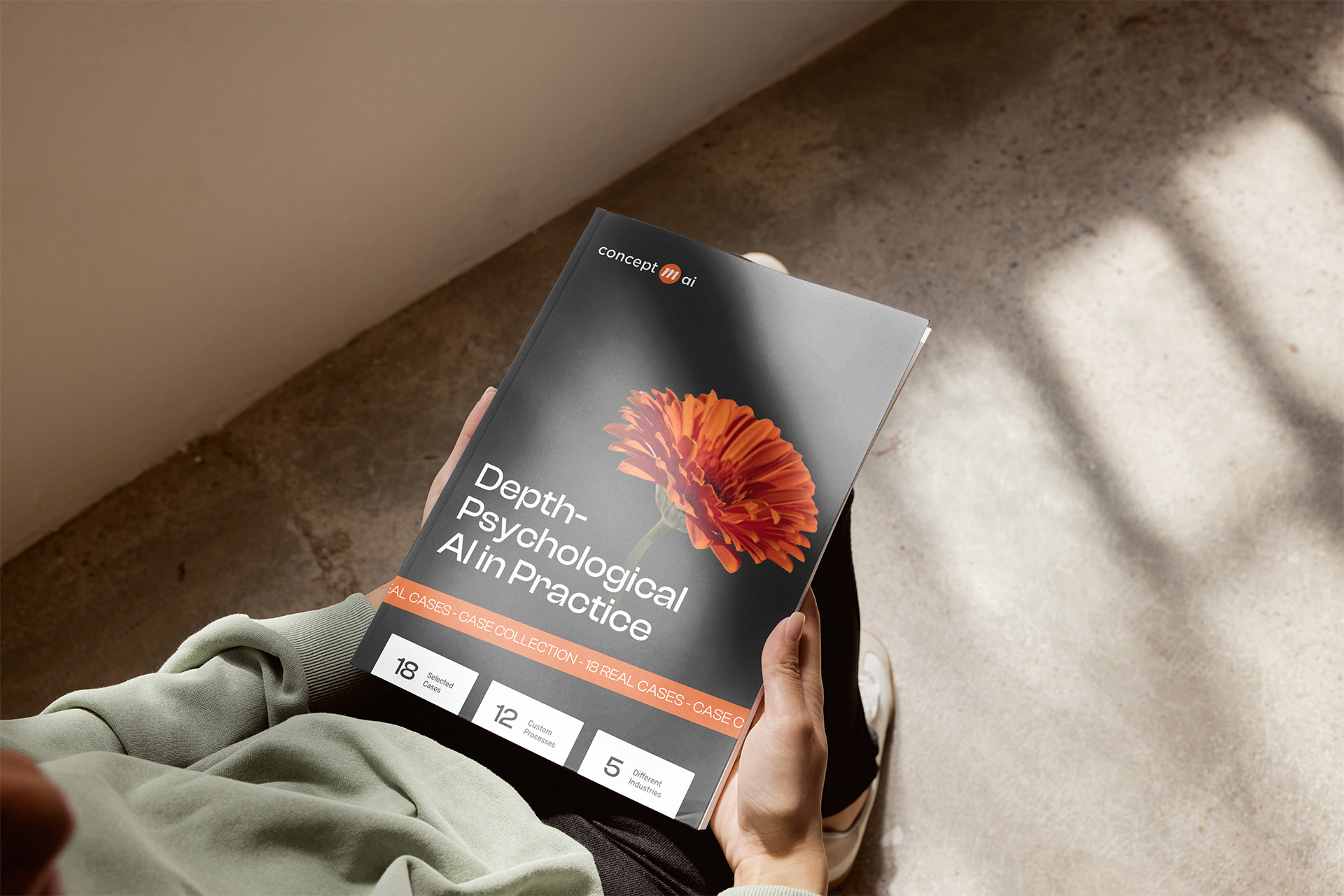
Case Collection ⦁ Free Download
Depth-Psychological AI in Practice
18 cases. 12 marketing processes. 5 industries. For each case: the challenge, the AI persona setup, and the measurable outcome. What’s inside:
Ready to bring
consumers to the table?
Choose your starting point. No pitch deck. No long sales process.
Your first steps with AI Sparring & Screening
You describe your challenge. We configure an AI persona prototype with a psychological match to your market, your target group, and your exact question. Use the AI persona for direct consumer feed back.
Explore AI-Integrated Workflows for your oranization
The opportunities for optimizing your marketing with A-integrated workflows are limitless - from iterative testing processes to complex agentic systems embedded in your organization. We are glad to share our experience.